




James Harding
04/06/2026
How to Select Load Balancing for EV Chargers
A charger that looks right on paper can still be wrong for the property if load balancing has been treated as an afterthought. That is usually where problems start – nuisance tripping, restricted charge speeds, expensive remedial work, or a system that cannot scale when a second EV arrives. If you are working out how to select load balancing for EV chargers, the real job is matching the control method to the site’s electrical limits, not simply choosing a charger with a smart app.
For UK homes, blocks of flats and commercial sites alike, load balancing is what allows charging to happen without overloading the incoming supply. It monitors available capacity and adjusts charger output accordingly. The right choice depends on the size of the supply, how many chargers are being installed, whether the site is single-phase or three-phase, and whether future expansion matters from day one.
What load balancing actually needs to do
At its simplest, load balancing prevents the total demand of a property or site from exceeding what the electrical infrastructure can safely support. That might mean reducing the charging rate when the cooker, shower and heat pump are all running in a home. In a commercial setting, it might mean sharing a limited supply across several charge points during working hours and releasing more power overnight.
This is why there is no single best load balancing setup for every charger. Some systems only manage one charger against the rest of the building load. Others can distribute capacity dynamically across multiple chargers. Some are excellent for domestic installs but become restrictive on larger projects. Others are designed for scale but are excessive for a straightforward driveway installation.
How to select load balancing for EV chargers at home
For most domestic buyers, the first question is whether the property actually needs dynamic load balancing or whether the charger’s standard power limits are enough. If the home has a modest incoming supply, high existing electrical demand, or other major loads such as electric heating, solar diverters or battery storage, dynamic load balancing is often the safer route.
A typical single charger on a standard home installation may work perfectly well with a dedicated circuit and correct protective devices. But if the maximum demand is already tight, a charger that can automatically reduce output in response to household load is usually the better long-term choice. It helps avoid overloading the main fuse and can reduce the chance of DNO-related issues later.
Where a homeowner expects to add a second charger in future, that changes the decision. In that case, it is worth choosing a charger platform that supports charger-to-charger load sharing rather than buying purely on the basis of today’s single-vehicle requirement. Replacing hardware later is rarely the cheapest option.
Static vs dynamic load balancing
Static load balancing sets a fixed charging limit based on the known capacity available. It is simple and often cost-effective, but it does not respond to changing site demand. If the rest of the property uses less power than expected, the charger still stays capped. That means capacity can be left unused.
Dynamic load balancing measures actual site consumption and adjusts charging output in real time. For homes with variable demand and for commercial sites with changing occupancy, this is usually the more efficient option. The trade-off is that it often requires additional metering, CT clamps or a dedicated energy management device, so installation complexity and upfront cost can be higher.
In practice, static balancing can suit predictable, constrained installations. Dynamic balancing tends to be the stronger choice where flexibility, performance and futureproofing matter more.
Single-phase or three-phase changes the answer
Phase configuration matters more than many buyers expect. A single-phase domestic property has less headroom, so load balancing is often critical when adding EV charging alongside other significant loads. Three-phase sites can support higher total demand, but they also introduce phase balancing considerations, especially where multiple chargers are involved.
On a three-phase commercial installation, it is not enough to know the total available power. You need to understand how that power is distributed across phases and whether the charging system can manage loads intelligently. Poor phase allocation can create constraints even when the overall supply appears generous.
For installers, this is where product selection needs to go beyond charger brand preference. The charger and its load management accessories must fit the supply type and the wider distribution design.
How many chargers are being installed
The jump from one charger to several chargers is where load balancing becomes a system decision rather than a product feature. A single domestic charger may only need local dynamic load management tied to the property’s incoming supply. A bank of chargers in a workplace, car park or mixed-use development typically needs group load balancing.
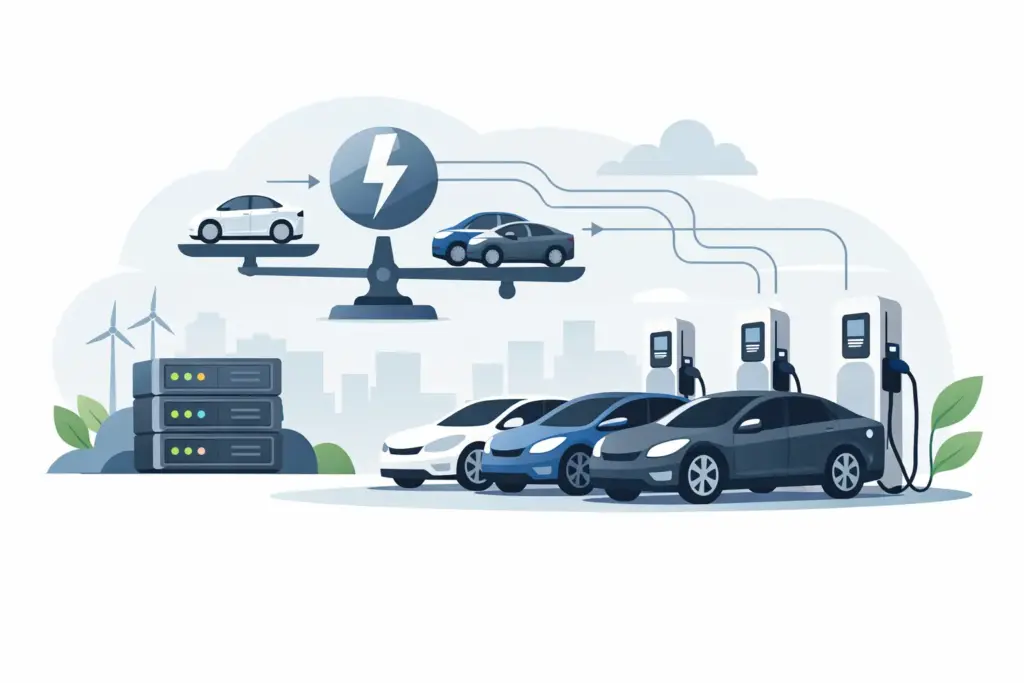
Group load balancing allows multiple chargers to share a defined capacity pool. That means one charger does not take full available power while others sit waiting. It also makes better use of infrastructure, which can help avoid unnecessary upgrades to the supply.
If the site may expand later, check whether the platform supports additional chargers without replacing the original control architecture. Some ecosystems are easy to extend, while others become awkward once you move beyond the first few sockets.
Don’t separate load balancing from the rest of the installation
A common mistake is to choose the charger first and think about load balancing second. In reality, the charger, protection devices, earthing arrangement, communications method and metering requirements all need to line up.
For example, some chargers need brand-specific accessories for dynamic load management. Others rely on external meters or gateway devices. Some multi-charger systems need stable data cabling or network configuration to function properly. If those requirements are missed at quotation stage, the install can quickly become slower and more expensive than expected.
This matters for domestic jobs, but even more so for trade buyers pricing commercial work. The cost is not just the charger. It is the complete, compliant package – charger hardware, mounting, load management components, circuit protection and any communications equipment needed to make the system work as intended.
Site behaviour matters as much as electrical capacity
When considering how to select load balancing for EV chargers, think about usage patterns rather than headline charger speed alone. A home where the vehicle charges overnight for a few hours has very different needs from a workplace where several vehicles plug in at 9 am and all need meaningful energy by lunchtime.
If users can tolerate variable charging rates, a shared power model works well. If charging windows are short and demand is high, you may need more available capacity, more intelligent scheduling, or a combination of load balancing and energy storage. Load balancing cannot create power that the site does not have. It simply allocates limited capacity more intelligently.
That is why commercial buyers should be cautious about overpromising charge speeds based on charger rating alone. Real-world output depends on the site supply and the balancing strategy behind it.
Questions worth answering before you buy
The best buying decisions usually come from a short technical checklist. What is the incoming supply rating? Is the site single-phase or three-phase? What are the existing major loads? How many chargers are needed now, and how many later? Does the chosen charger require additional hardware for load management? Can the system balance across multiple units, or only against the building load?
You should also ask how the site will be used. Domestic overnight charging, fleet return-to-base charging and public or semi-public destination charging all place different demands on the system. A charger that is perfectly suitable for a single home may not be suitable for a workplace car park, even if the output rating looks similar.
For trade customers, product availability matters too. It is far easier to deliver jobs smoothly when chargers, protection, accessories and mounting options can all be sourced together. That reduces compatibility surprises and helps keep installation planning tight.
Choosing for today without creating problems later
The cheapest way to add EV charging is not always the lowest-cost charger. If load balancing is underspecified, the savings can disappear in call-backs, upgrades and frustrated users. Equally, overspecifying a small domestic job with a complex commercial control setup is not good value either.
The right answer usually sits in the middle: enough intelligence to protect the supply, enough flexibility to suit real usage, and enough scalability to avoid repainting the whole job when requirements change. For buyers comparing recognised charger brands and install-ready components, UK EV Installers Shop is built around that practical approach – selecting the charger is only part of selecting the system.
If you are unsure, start with the site limit, not the charger brochure. Once you know what the supply can realistically support, the right load balancing option becomes much easier to pin down.
Home EV Chargers Explained for UK Buyers
Home EV chargers explained for UK buyers – compare charger types, power, smart features, installation needs and what matters before you buy.Can I Use Solar With EV Charger at Home?
Can I use solar with EV charger systems at home? Learn what works, what equipment you need, and the limits of solar…myenergi libbi review for UK homes
Our myenergi libbi review looks at performance, backup options, solar pairing, installation factors and whether it suits UK homes today.