




James Harding
05/05/2026
What kW Are Home EV Chargers?
If you are asking what kW are home EV chargers, the short answer is that most UK home units are either 3.6kW or 7kW, with 22kW available in more limited situations. That headline figure matters because it tells you the maximum rate at which the charger can supply power to the vehicle, but it is only part of the picture. Your property supply, your car’s onboard charger, and how you actually use the car all affect what makes sense.
For most domestic installations, 7kW is the standard choice. It offers a good balance between charging speed, installation practicality and compatibility with typical single-phase UK homes. That is why you will see most leading home charger models built around 7kW output rather than chasing bigger numbers that many properties cannot use.
What kW are home EV chargers in the UK?
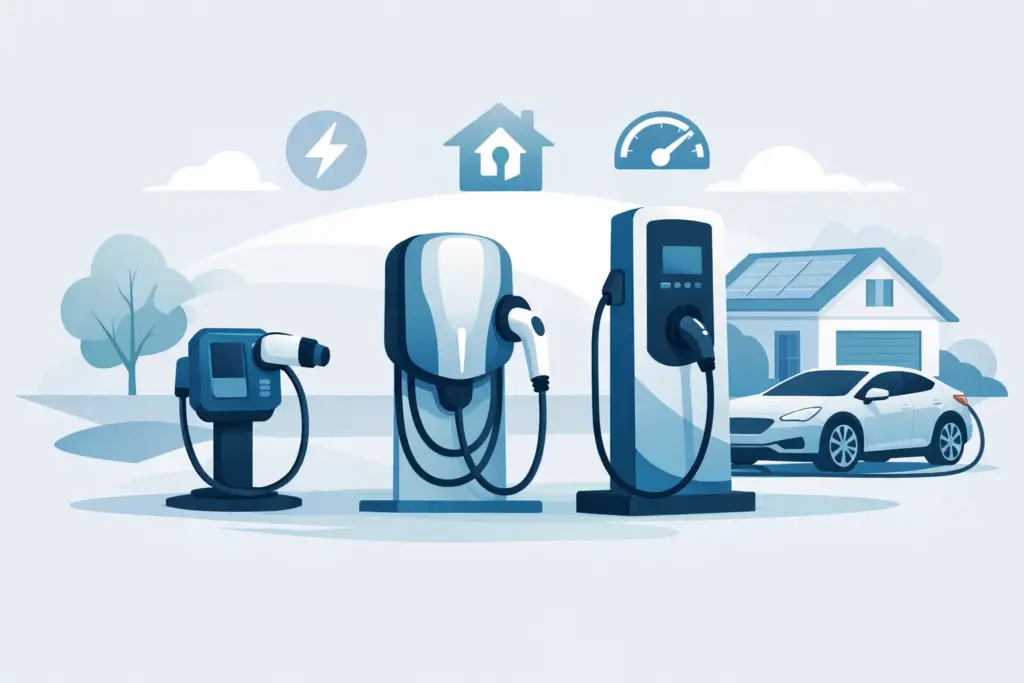
In practical terms, UK home EV chargers usually fall into three power ratings.
A 3.6kW charger is often found where available electrical capacity is tighter or where a lower-power installation is preferred. It is slower, but for drivers covering modest daily mileage and charging overnight, it can still be perfectly workable.
A 7kW charger is the most common domestic option. On a standard single-phase supply, this is typically the best fit for a home installation. It is fast enough to recharge many EVs overnight and widely supported by mainstream home charging brands and tariff-compatible smart charging features.
A 22kW charger exists, but it is not a standard answer for most houses. It usually requires a three-phase supply, which many UK homes do not have. Even where three-phase is available, the vehicle must also be able to accept 22kW AC charging. If either side cannot support that rate, the charger will not deliver the headline output.
What the kW rating actually means
The kW figure refers to power, not battery size. Think of it as the charging rate rather than the amount of energy stored. Your car battery is measured in kWh, while the charger output is measured in kW.
That distinction matters because a larger battery does not always mean you need a more powerful charger. It may simply mean the car needs longer to charge. A 7kW charger charging a 60kWh battery will take less time than the same charger charging a 90kWh battery, but the charger itself has not changed.
This is also why charging time estimates are always approximate. Losses, battery temperature, charging curve behaviour and the car’s own limits all affect the real result.
Why 7kW is usually the right answer
When homeowners ask what kW are home EV chargers, they are often really asking what they should buy. In most cases, the answer is 7kW.
The reason is straightforward. Most UK homes have a single-phase supply, and 7kW is the standard maximum output for a typical single-phase domestic charger. It gives a useful step up from a 3-pin plug without the extra complexity of moving into three-phase equipment.
For many EV owners, charging happens overnight or during off-peak tariff windows. A 7kW charger is usually enough to recover everyday driving comfortably within those periods. If you drive 20 to 50 miles a day, you do not need an ultra-high AC charging rate at home to stay topped up.
There is also a product and installation advantage. The 7kW category has the broadest choice across smart chargers, tethered and untethered models, load management accessories, and tariff-friendly options. For buyers who want a reliable, compliant domestic setup, it is normally the most efficient route.
When 3.6kW still makes sense
A lower-powered charger is not automatically the wrong charger. There are cases where 3.6kW is a sensible fit.
If the property has limited spare electrical capacity, a lower-output unit may reduce installation constraints. The same applies where an older supply arrangement, a smaller service head, or other significant loads in the home make full-rate charging less straightforward. Some installations can also manage these issues with dynamic load balancing, but not every job has the same starting point.
Usage pattern matters too. If the vehicle is parked for long periods and daily mileage is low, 3.6kW may still cover routine needs. It is slower, certainly, but slower is not always a problem if the vehicle is consistently charging for eight to twelve hours at a time.
Why 22kW is not common at home
A 22kW charger can sound attractive on paper, but domestic suitability is more limited than the number suggests.
First, most homes in the UK are single-phase. A 22kW AC charger normally needs a three-phase supply, which means the property must already have one or be upgraded. That upgrade is not always available, simple or cost-effective.
Second, many EVs cannot accept 22kW AC charging anyway. A large number of vehicles cap AC charging at 7kW or 11kW. So even with the right charger and supply, the car may still take less. Paying for a higher-rated unit does not create charging capability that the vehicle does not have.
This is one of the main trade-offs in charger selection. Bigger numbers are only useful when the whole system can use them.
The charger does not always decide the speed
People often assume the wallbox alone determines charging performance. In reality, the delivered rate is set by the lowest limit in the chain.
The property supply may limit the charger. The charger settings may limit the output. Load management may reduce charging rate temporarily to protect the installation. The car’s onboard AC charger may also cap the speed below the charger’s rated output.
For example, a 7kW charger connected to a vehicle that only accepts 3.6kW AC will still charge at roughly 3.6kW. Likewise, a 22kW charger paired with an 11kW-capable car will only deliver up to 11kW, assuming the supply supports it.
That is why charger buying should always start with compatibility, not headline speed alone.
Choosing the right kW for your home EV charger
The best way to choose is to look at the installation as a whole rather than picking the highest output available.
Start with the property. Is the supply single-phase or three-phase? Is there enough spare capacity, or will the charger need load balancing and additional protection? For installers, this is where site assessment and compliant design matter. For homeowners, it is where a seemingly simple charger choice can become a broader electrical decision.
Then look at the vehicle. What is the maximum AC charging rate it can accept? A car that tops out at 7kW does not benefit from a 22kW home charger. A plug-in hybrid with a much smaller battery may also not need the same charging setup as a full battery EV with higher daily use.
Finally, consider how the vehicle is used. If the car is home every evening and charging overnight, 7kW is usually more than enough. If charging windows are shorter, mileage is high, and the property has three-phase available, the case for a higher-output unit becomes more credible.
Smart charging matters as much as charger size
Power rating is only one part of a good home charging setup. In many homes, smart functionality has as much impact on day-to-day value as the charger’s kW rating.
A well-matched smart charger can schedule charging around off-peak tariffs, respond to solar generation, and work with load management devices to keep the installation within safe operating limits. That can matter more to running cost and installation practicality than moving from one charger size to another.
For buyers comparing products, the right question is often not just what kW are home EV chargers, but which charger combines the right power level with the right control features, cable format, and protection setup for the property.
A realistic way to think about charger size
If you want a simple rule of thumb, treat 7kW as the default UK home answer, 3.6kW as the lower-power option that still suits some properties, and 22kW as a specialist domestic choice for the right three-phase setup.
That approach avoids two common mistakes. The first is under-specifying a charger when a standard 7kW unit would have delivered better everyday convenience. The second is over-specifying a charger based on headline numbers that the home supply or vehicle cannot fully use.
For both homeowners and installers, the best result usually comes from matching charger rating, vehicle capability and site conditions from the start. A correctly specified 7kW charger will outperform an ill-matched higher-rated unit every time in practical domestic use.
If you are weighing up charger options, focus on the complete installation rather than the biggest number on the box. That is usually where the best long-term value sits.
How to Lock Home EV Charger Access
Learn how to lock home EV charger access with app settings, RFID, cable locks and physical measures to reduce misuse and improve…myenergi libbi review for UK homes
Our myenergi libbi review looks at performance, backup options, solar pairing, installation factors and whether it suits UK homes today.How to Select Load Balancing for EV Chargers
Learn how to select load balancing for EV chargers based on supply, charger count, phase setup and site use to avoid overloads…