




James Harding
19/05/2026
AC vs DC Charging: What’s the Difference?
If you are comparing chargers for a home install, a workplace bay or a public site, AC vs DC charging is one of the first distinctions that actually changes what you should buy. It affects charging speed, equipment cost, installation complexity and, just as importantly, whether the setup suits the vehicle and the electrical supply available on site.
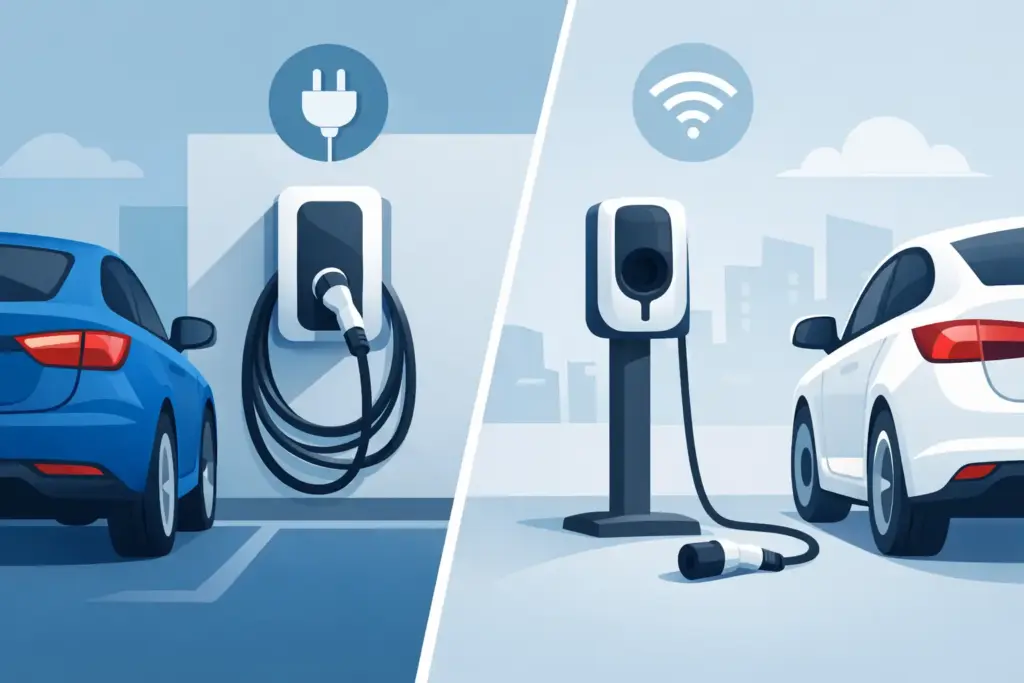
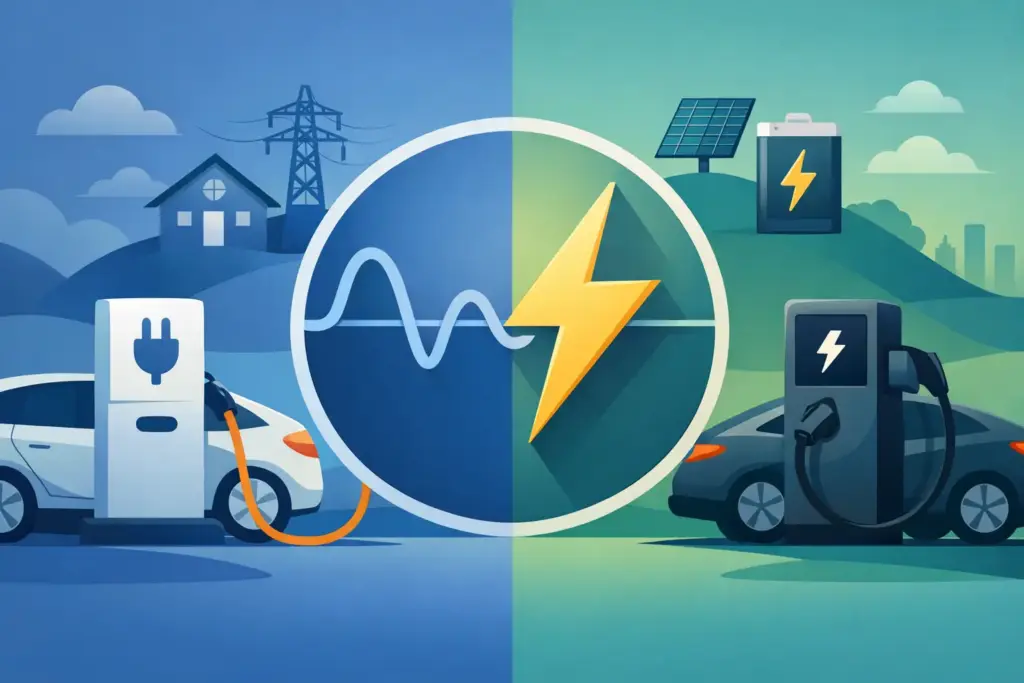
A lot of confusion comes from the fact that every EV battery stores DC power, but many charging points supply AC. The missing piece is the vehicle’s onboard charger. With AC charging, the car converts AC from the grid into DC for the battery. With DC charging, that conversion happens in the charger itself, so power goes straight to the battery at a much higher rate.
AC vs DC charging in simple terms
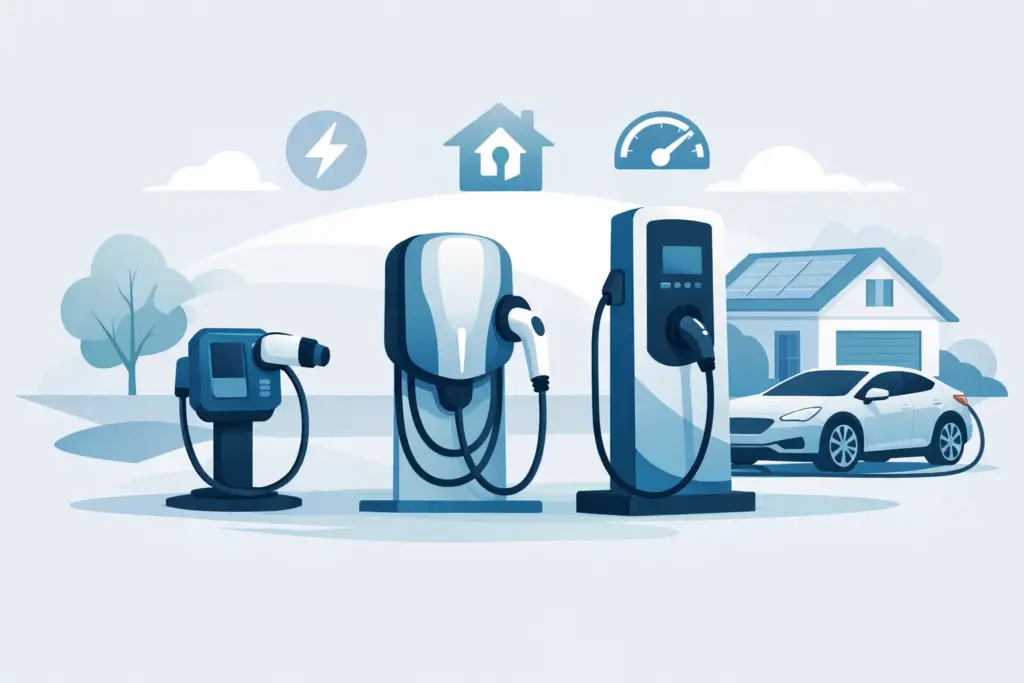
For most UK homes, AC charging is the standard option. A domestic wall charger typically supplies 7.4kW on a single-phase supply, with some properties and commercial sites able to support 22kW on three-phase where both the vehicle and installation allow it. This is the familiar overnight charging model – lower hardware cost, practical installation and enough speed for day-to-day driving.
DC charging is the rapid and ultra-rapid side of the market. Instead of relying on the car’s onboard charger, the unit handles conversion externally and pushes DC directly into the battery. That is why DC chargers can deliver far higher outputs, from around 24kW upwards to 50kW, 100kW, 150kW and beyond, depending on the unit, the vehicle and site capacity.
The short version is simple. AC is usually the right fit for home and longer dwell times. DC is usually the right fit when vehicles need a faster turnaround and the budget, load capacity and use case justify it.
Why AC charging is the default for homes
For a homeowner, AC charging is usually the sensible choice because it matches how the vehicle is used. Most cars are parked for hours overnight, so there is no strong need to pay for rapid charging hardware. A 7.4kW AC charger can add meaningful range over an evening or overnight session, and smart charging features can help align usage with off-peak electricity tariffs.
This matters because the wider charging decision is not just about speed. It is also about total installed cost, electrical compatibility and ongoing value. An AC home charger is normally far more affordable to buy and install than any DC equivalent, and the supporting infrastructure is much more straightforward.
For installers, AC charging is also more predictable from a domestic design point of view. You are typically dealing with standard home charging products, established protective devices, load management options and tariff-aware functionality. The job still needs to be specified correctly, but it is generally a cleaner proposition than trying to introduce high-power DC equipment into a domestic setting.
Where DC charging makes sense
DC charging earns its place where time on site is limited or vehicle utilisation is high. That includes public rapid charging, fleet depots, commercial premises, forecourts and some workplace settings where drivers need to recover a large amount of range quickly.
This is where buyers sometimes make the wrong comparison. They see DC as simply the faster version and assume it is automatically better. In practice, the question is whether faster charging solves a real operational problem. If vehicles sit on site all night, AC is often enough. If vans return between shifts and need to get back out quickly, DC starts to make commercial sense.
For commercial projects, the charger itself is only part of the equation. Site supply capacity, civil works, switchgear, protection, mounting, payment options, communications and back-office considerations all come into play. A DC installation is usually a wider infrastructure decision, not just a product swap.
Speed depends on more than AC vs DC charging
Charging speed is never determined by the charge point alone. The vehicle’s limits matter just as much.
With AC charging, the vehicle’s onboard charger is often the limiting factor. For example, a charger may be capable of 22kW AC, but if the vehicle can only accept 7.4kW or 11kW AC, that is the maximum it will take. This is why checking vehicle compatibility matters before specifying higher-output AC equipment.
With DC charging, the car’s battery management system and peak DC acceptance rate become the constraint. A 150kW charger does not mean every connected vehicle will charge at 150kW. Some will take much less, and most will only hold their peak rate for a limited portion of the session before tapering down.
That taper is worth understanding. DC charging is fastest when the battery is at a lower state of charge. As the battery fills, the charge rate usually drops to protect battery health and manage heat. So if the target is getting from 10 to 80 per cent quickly, DC works very well. If the target is sitting at 100 per cent, the speed advantage narrows.
Cost, complexity and infrastructure differences
The gap between AC and DC is not only technical. It is commercial.
AC chargers are cheaper to purchase, easier to deploy and generally easier to integrate into domestic and light commercial sites. They also place less extreme demands on the electrical infrastructure. For many buyers, that makes AC the higher-value option even if it is slower.
DC chargers sit at the opposite end of the scale. They are significantly more expensive, larger, heavier and more demanding in terms of site design. You may need substantial upstream electrical work, dedicated distribution arrangements and more involved commissioning. Maintenance expectations can also be higher, particularly in public or high-use environments.
That does not make DC poor value. It simply means the value case depends on throughput. If charging speed directly supports revenue, vehicle availability or customer convenience, the higher capital outlay can be justified. If not, it can be unnecessary overspecification.
Connector types and practical compatibility
In the UK, AC charging for modern EVs is typically through a Type 2 connection. DC rapid charging is commonly delivered through CCS, with CHAdeMO still relevant for a smaller portion of the vehicle parc. Compatibility checks remain essential, especially on mixed fleets or older vehicles.
For home buyers, the practical decision is usually tethered versus untethered, cable length, smart features and load balancing rather than AC versus DC, because DC is rarely the domestic choice. For trade buyers and commercial specifiers, the compatibility picture broadens to include connector standards, payment hardware, site access, signage and user management.
Which option is better for installers and project specifiers?
If the site is a house, AC is almost always the right place to start. The key specification points are supply type, earthing arrangement, protective devices, PME considerations, load management, cable route and whether the customer wants solar integration or tariff-based smart charging.
If the site is commercial, the answer depends on dwell time and business model. Hotels, offices and destination venues often suit AC because vehicles remain parked for longer periods. Forecourts, fleet depots and high-turnover public locations are more likely to justify DC. Some of the best sites use both – AC for longer stays and DC for drivers who need a quick top-up.
This blended approach is often the most realistic. It keeps capital spend aligned with how bays are actually used instead of assuming every charging space needs to be rapid.
How to choose between AC and DC charging
A good buying decision starts with a few direct questions. How long will the vehicle usually be parked? How much range needs to be added in that time? What power is available on site? What does the vehicle itself support? And what budget is realistic once hardware and installation are both included?
For homeowners, the answer is usually straightforward. If the car is parked overnight and you want dependable, tariff-aware charging, AC is the practical route. For businesses, the answer is more site-specific. If charging speed affects operations, customer turnover or fleet readiness, DC may be the right investment, but only if the infrastructure can support it and utilisation is there.
That is why product range matters. Choosing correctly often means comparing not just chargers, but also protection devices, mounting options, cabling, access control, payment systems and load management. A supplier with depth across both consumer and trade requirements makes that process easier because the charger can be matched to the full installation rather than considered in isolation.
At UK EV Installers Shop, that distinction matters every day. Some customers need a straightforward home charger that works with an off-peak tariff. Others need a complete commercial charging setup with the right supporting hardware. AC and DC both have a place – the key is choosing the one that fits the vehicle, the site and the job rather than chasing headline speed. If the charging setup works with the way people actually park and drive, it will usually be the right one.
Types of Home EV Chargers Explained
Learn the main types of home EV chargers, from socket and tethered units to smart and solar-ready options, and choose the right…What Is a Home EV Charging Station?
What is a home EV charging station? Learn how it works, charger types, power ratings, installation needs and what UK buyers should…Home EV Chargers Explained for UK Buyers
Home EV chargers explained for UK buyers – compare charger types, power, smart features, installation needs and what matters before you buy.