




James Harding
03/05/2026
Types of Home EV Chargers Explained
A 7kW wallbox is the option most UK drivers end up with, but that does not mean it is the right answer in every case. When comparing the different types of home EV chargers, the best choice depends on your vehicle, parking arrangement, tariff, consumer unit capacity and whether you want features such as solar integration or load balancing.
For some buyers, the decision is mainly about convenience. For others, it is about compliance, cable management or making sure the charger works properly with off-peak electricity rates. If you are buying for your own property or specifying for a customer, it helps to separate charger types by how they connect, how they charge and what control features they offer.
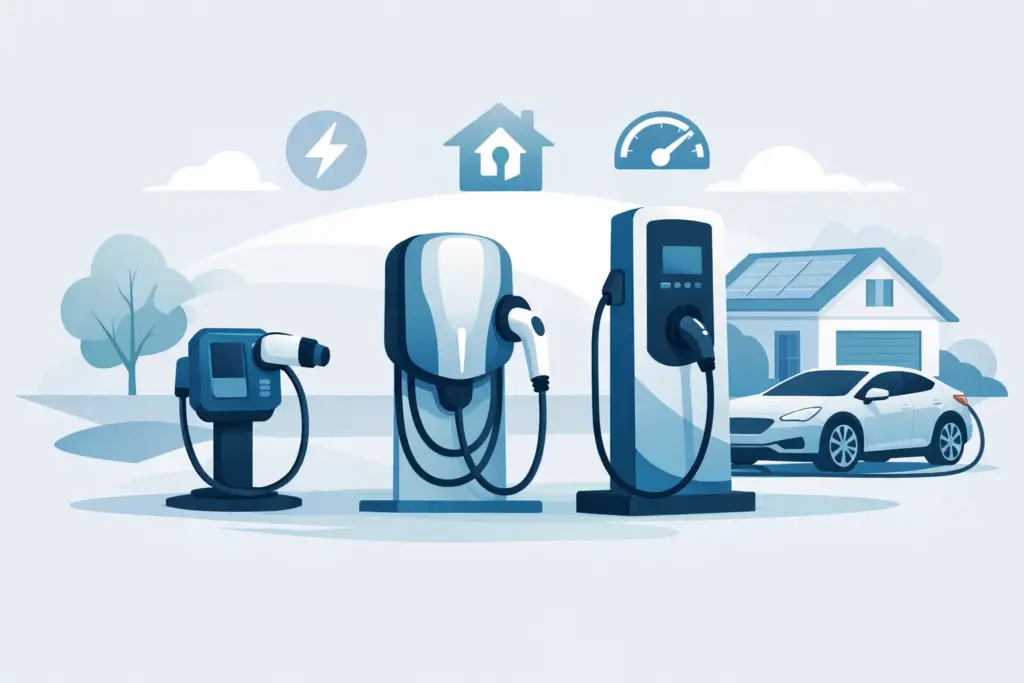
The main types of home EV chargers
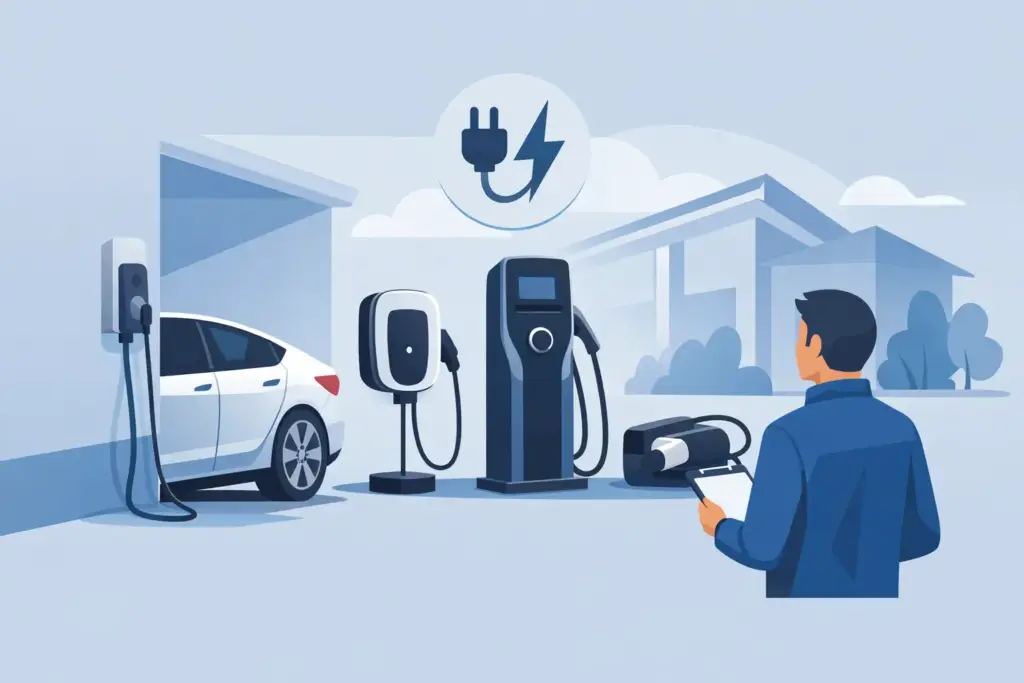
Most home charging setups in the UK fall into a few clear categories. You can group types of home EV chargers by charging speed, cable format and smart functionality. In practice, the charger you choose often sits across more than one category at once.
3-pin socket charging
This is the slowest home charging method and uses a standard domestic socket with a portable charging lead, often called a granny charger. It can be useful as a backup or for occasional low-mileage use, but it is rarely the best long-term solution.
Charging is much slower than with a dedicated wallbox, and regular prolonged use on an ordinary socket is not ideal for most households. For drivers covering meaningful weekly mileage, a proper home charger is usually the more practical and dependable option.
Fast AC wallboxes
For most UK homes, fast AC chargers rated around 7kW are the standard choice. They are designed for single-phase domestic supply and offer a much better balance of charging speed, safety and usability than a 3-pin socket.
A 7kW charger will typically recharge an EV overnight, which suits most domestic routines. Some properties may be able to accommodate higher output units, particularly where three-phase supply is available, but that is less common in standard residential settings.
Three-phase home chargers
Where a property has a three-phase electrical supply, a home charger may be able to deliver 11kW or 22kW AC charging, subject to vehicle compatibility. This is a more specialist domestic option and is more commonly seen in larger properties, rural installations, mixed-use sites or homes with workshop-style electrical infrastructure.
The key limitation is that the car itself must be able to accept that higher AC rate. A 22kW charger does not guarantee 22kW charging if the vehicle onboard charger is limited to 7kW or 11kW. This is one of the most common specification errors, so it is worth checking both the property supply and the vehicle capability before buying.
Tethered and untethered chargers
One of the most important buying decisions is whether the charger has a fixed cable.
Tethered chargers
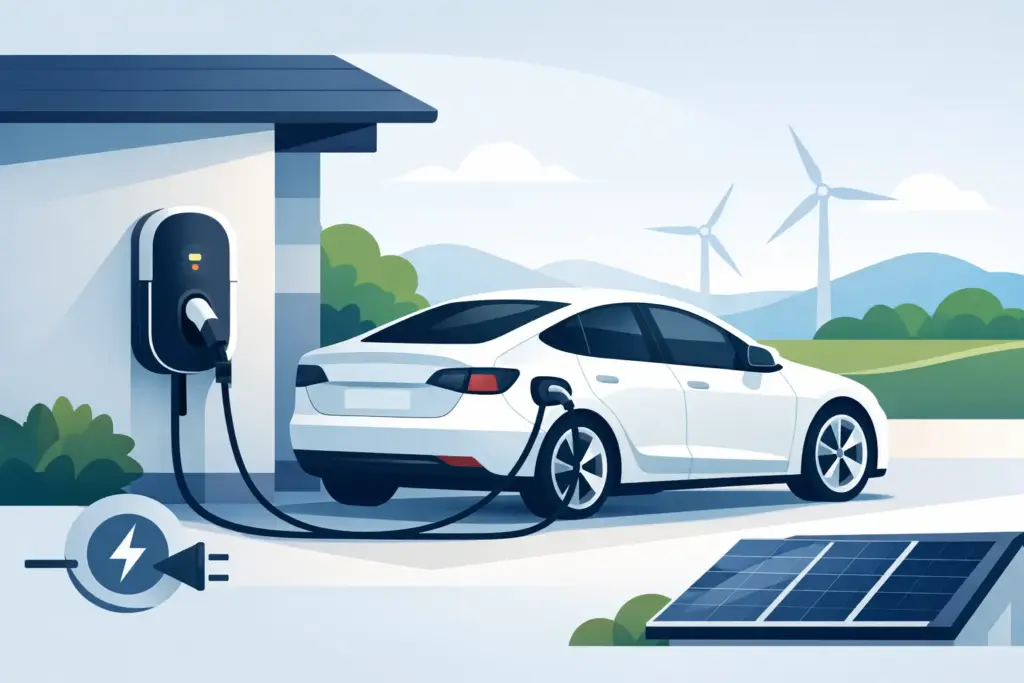
A tethered charger comes with a built-in cable permanently attached to the unit. For many homeowners, this is the easiest option. You park, plug in and charge without needing to get the charging lead out of the boot every time.
It is particularly convenient for daily use and can help keep the routine simple for busy households. The trade-off is compatibility flexibility. If you change vehicle connector type in future, or if multiple vehicles with different requirements use the charger, a tethered unit can be less adaptable.
Cable length also matters. A badly chosen cable length can make installation look tidy but daily charging awkward, especially if the vehicle charge port position changes between cars.
Untethered chargers
An untethered charger has a socket on the unit rather than a fixed lead. You supply and connect your own charging cable when needed. These units often suit households that want a cleaner look on the wall or more flexibility across different vehicles.
They can also make sense where the charger is visible at the front of a property and a permanently coiled cable would be less desirable. The obvious compromise is convenience. You need to store, handle and connect the lead separately each time.
For installers and trade buyers, untethered models can be useful where future vehicle changes are likely or where a site specification calls for a more universal presentation.
Smart chargers and standard chargers
Since UK regulations have pushed the market strongly towards connected charging, most domestic wallboxes now include smart features. Even so, it is worth understanding what “smart” actually means in buying terms.
Smart home EV chargers
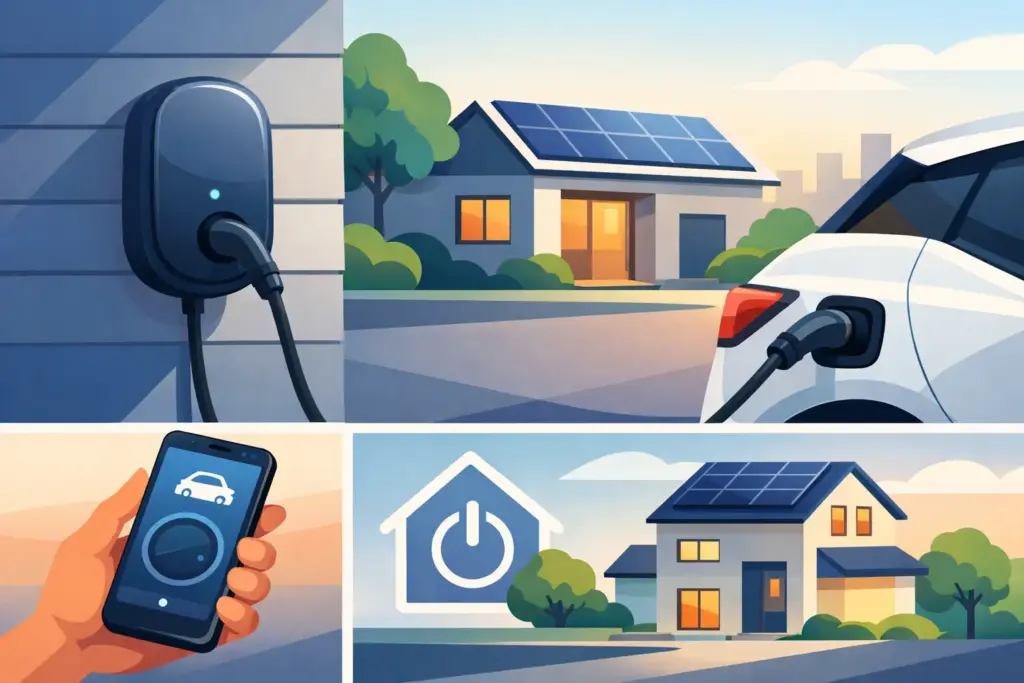
Smart chargers connect by Wi-Fi, Bluetooth, Ethernet or mobile data and allow app-based control. This usually includes scheduled charging, charging history, remote start and stop, and tariff optimisation.
For drivers on time-of-use tariffs, this can make a significant difference to running costs. Some chargers are built specifically with off-peak charging in mind and integrate well with EV-friendly tariffs. If the aim is to reduce charging costs rather than simply add miles quickly, smart functionality is often one of the most valuable features on the unit.
Many smart chargers also support load management. That means the charger can adjust output to avoid overloading the incoming supply when the house is using other heavy electrical loads. In properties with heat pumps, electric showers, battery storage or other high-demand equipment, this can be especially useful.
Basic or less connected chargers
Some buyers want the simplest possible charging setup with minimal app reliance. There is still a place for straightforward units, but availability is more limited than it once was, and regulatory requirements have changed the market.
A simpler charger may suit a user who wants plug-and-charge behaviour without much interest in tariffs, remote control or energy data. Still, in most current UK domestic cases, smart charging features are no longer a luxury extra. They are part of choosing a modern, compliant charger that can work well within the home energy setup.
Solar-compatible and energy-integrated chargers
Another useful way to compare types of home EV chargers is by how they interact with the rest of the property.
Solar-ready chargers
Some chargers are designed to work with solar PV generation, allowing the vehicle to charge using excess solar where conditions permit. This appeals to homeowners already investing in low-carbon energy systems and to installers delivering combined solar, battery and EV charging projects.
The benefit is obvious when generation and charging demand line up, but there are practical limits. UK solar output is variable, and many vehicles need a minimum charging current to start charging effectively. In real use, solar-only charging can be excellent on bright days but less reliable as the sole charging method year-round.
Chargers with load balancing and energy management
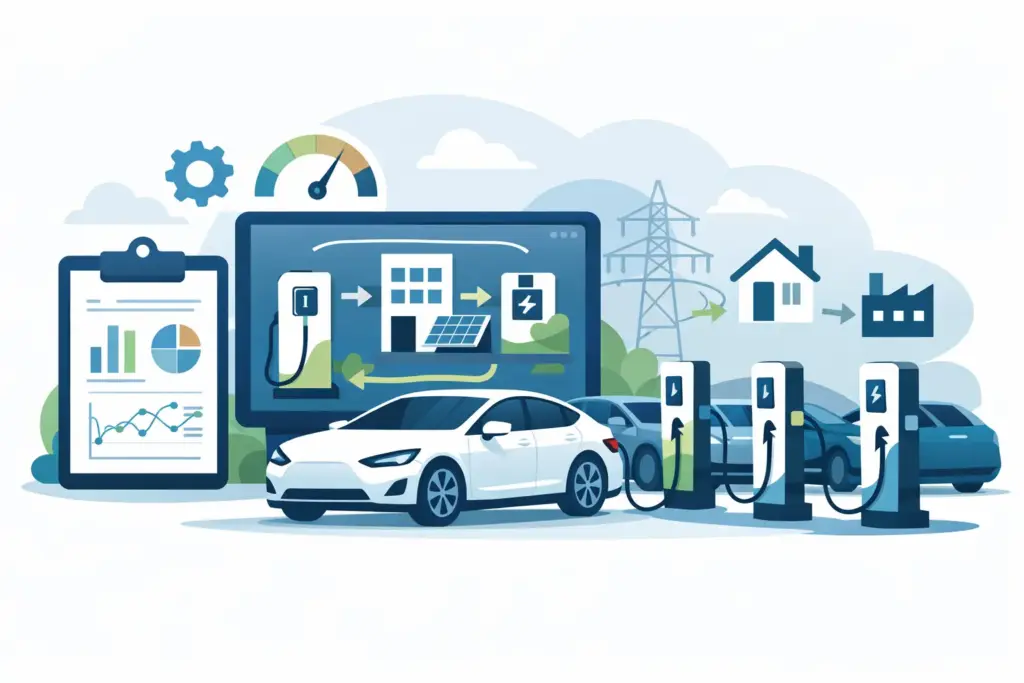
Homes are increasingly being fitted with more electrified systems – EV charging, heat pumps, batteries and solar all competing for available capacity. Chargers with dynamic load balancing or wider energy management features help make that workable.
This matters not just for convenience but for installation viability. In some cases, intelligent load control can avoid the need for more costly supply upgrades. It can also improve how well the charger fits into a broader renewable system, which is particularly relevant for trade customers sourcing complete project materials.
Single-phase versus three-phase at home
This is not always presented as one of the main types of home EV chargers, but it is a critical specification split. Most UK homes are single-phase, which makes 7kW charging the normal domestic benchmark. A charger rated above that does not automatically mean faster charging unless the property supply supports it.
Three-phase chargers can be the right fit on the right site, but they are not a universal upgrade. For many homeowners, the extra charging capacity would go unused because either the supply or the car would limit the actual charge rate. Matching charger rating to real-world conditions is more useful than buying to the highest headline number.
What matters most when choosing between types of home EV chargers
The charger type should fit the vehicle and the property rather than the other way round. Start with the basics: single-phase or three-phase supply, cable preference, off-street parking layout and whether the user wants app control. Then look at the finer points such as tariff compatibility, solar integration, PME protection approach, load management and the accessories needed for a compliant installation.
For some households, a tethered 7kW smart charger is the clear answer because it offers quick daily use and tariff scheduling in one unit. For others, an untethered charger with a neater finish and broader compatibility is the better fit. Where solar and battery storage are already in place, energy integration may matter more than cable style.
From a trade perspective, charger selection also needs to account for job readiness. That includes protection devices, mounting options, cable routing, earthing arrangements and whether the chosen unit simplifies commissioning on site. A charger is only part of the installation, not the whole specification.
UK EV Installers Shop serves both domestic buyers and installers looking to source chargers, protection and installation essentials together, which is often the practical advantage when a straightforward home charging job turns out to have a few technical wrinkles.
The right charger is rarely the one with the longest feature list. It is the one that suits the vehicle, works with the property and makes charging easy enough that it becomes routine rather than a workaround.
What Is a Home EV Charging Station?
What is a home EV charging station? Learn how it works, charger types, power ratings, installation needs and what UK buyers should…Home EV Chargers Explained for UK Buyers
Home EV chargers explained for UK buyers – compare charger types, power, smart features, installation needs and what matters before you buy.AC vs DC Charging: What’s the Difference?
AC vs DC charging explained for UK EV drivers and installers. Compare speed, cost, hardware and best-fit use cases for home and…